
★★★★★
“I am autistic”

Towards the end of A-Typical Rainbow the central character, Boy, says these three simple words. For JJ Green, the actor and author of the play, they are not just words in a script, but words that relate to his own life.
I cannot express how important this play is. This needs to be seen and understood.
With a cast of just five at the intimate Turbine Theatre, we begin with Boy (JJ Green), a 7 year old child recently diagnosed with Asperger’s Syndrome (the play does not discuss the problematic nature of this term and does reflect the diagnostic process in the late 1990s when it is set). His mother (Catherine Deverill) and father (James Westphal) try to come to terms with this in very different ways. Whilst Mother seeks to understand her son and do the best for him, Father struggles to accept that his son is not the son he was expecting to have. He won’t go and play football and wants to play with his mermaid doll.
We learn of the fantasy world that Boy creates in his head. One that he creates so clearly that to him it is real. Already we are seeing some of the myths of autism broken down. Many believe autistic people to have no sense of imagination, but I know from personal experience that this is not the case, and so, clearly, does the writer. We see Boy flying through the air on the back of a dragon or running through the forest with wolves. All of this creatively portrayed on the small stage by the cast thanks to the choreography of William Spencer.
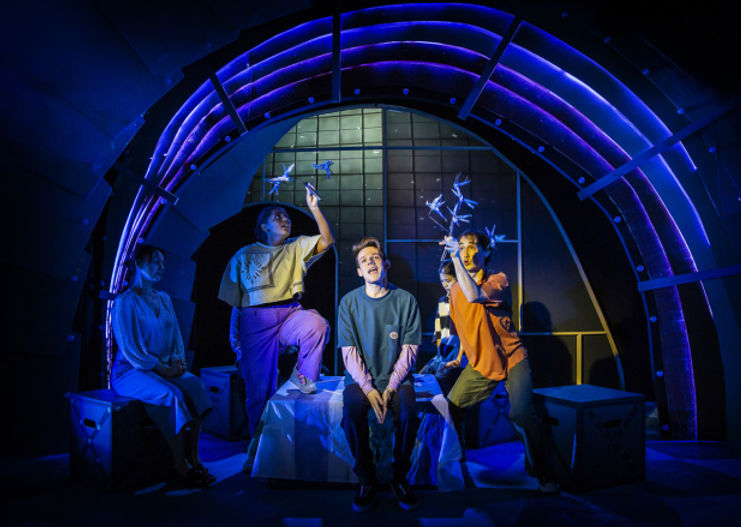
As he grows up, school, for Boy, is a minefield. Trying to navigate a neurotypical world that is not always accommodating is not easy. Here the play once again breaks down myths about autism as Boy’s reaction to events in his teacher’s life show a level of empathy.
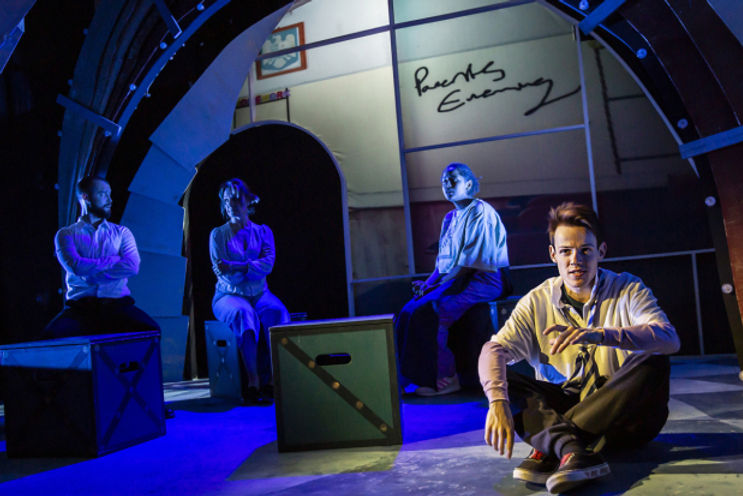
Yes, the classic tropes are there. Confusion of how it can be raining cats and dogs. Dislike of ‘ish’ because life doesn’t really work unless we are very specific on things. But they are there because they are true.
As he moves into adulthood his passion for acting and performing becomes clear. This is where another myth is broken down. Autistic people CAN put themselves in other people’s shoes. They CAN take on a role when on stage. We see one simple decision lead Boy down a certain path which will ultimately lead to sadness as he seeks to conform to the neurotypical world around him. With a twist at the end, we see him liberated and free to be true to himself.
The issue of sexuality is dealt with effectively here. It is based on JJ’s experiences growing up both autistic and queer. For me, this was secondary to the autistic experience, but that may have just been a personal interpretation and what I specifically identified with in the play.
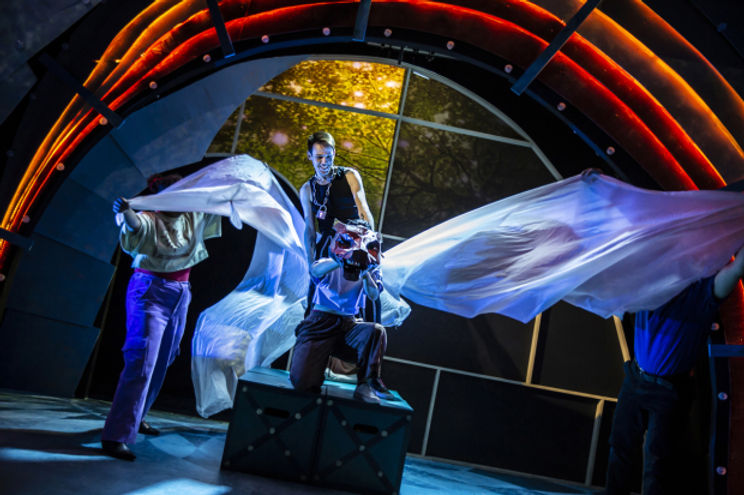
The small cast is completed with Conor Joseph (Jake/Daniel), Joy Tan (Abby/Thomas/Lara), and Maya Manuel (Emily/Mrs Whiteman/Rachel). Jack Chambers is the swing. A simple but effective set, designed by Frankie Gerrard sees a metal rainbow arch across the stage, acting as entrance point and allowing for some clever lighting transformations, designed by Bethany Gupwell. As director Bronagh Lagan expertly utilises the small stage and creates the world, with no more than a few blocks. My only criticism would be that, sitting on the front row, I could see off into the wings due to sightlines which distracted from the action on stage at a few points.
This is one what makes this new play unique. For the first time a truly authentic autistic voice is being heard in theatre. The last few years has brought much diversity to theatre with actors being cast based on their ability rather than their skin colour. This has opened the doors and given opportunities to many actors that they never had before: most notably the recent production of Legally Blonde at the Regent’s Park Open Air Theatre. But the same level of diversity has not necessarily been extended to actors with disabilities.
And this is where it gets personal for me. I feel that there are three audiences for this play. There is your neurotypical audience for whom I hope this will be an insight into the world of autism from the perspective of someone who is autistic, rather than an author just writing about it. Your second audience is parents of autistic children. For many, the scenes surrounding the diagnosis and the conflict at mealtimes will be familiar. And finally, the third audience is the autistic community.
I fit into two of these. In the words of Boy, ‘I am autistic’. I also have an autistic son who was diagnosed at the same age as Boy. I could relate a lot to what Mother went through in the play. However, I want to talk about being autistic myself.
We NEED autistic voices, both on stage and off stage. Reading through the programme it was so lovely to see that a large percentage of both cast and creative are neuro diverse. Talking to my son on the way home from the theatre we each identified with different aspects of the play. For him, the scene with the teacher really resonated. For me, it was the fantasy and imaginary world. I was not diagnosed until my mid-40s (as is happening more and more with females) and even when I started to suspect that I might be autistic, I felt I was being silly. I’d seen the autistic characters portrayed in the media. I’d read books with autistic characters. They had no imagination. Everything was factual. Me, I wrote stories. I found comfort and solace in the drama department at school. I was truly happy when on stage (and still regularly perform in amateur productions). But all along the idea that you couldn’t be like this and be autistic was there. So instead, I just assumed there was something ‘wrong’ with me. Maybe I was just unlikeable? Maybe I was stupid and just couldn’t work out how to fit in and be like everyone else. If I’d seen something like ‘A-typical Rainbow’ as a teenager I would have seen myself represented on stage.
It is worth mentioning here that a trigger warning is given in the programme that there are ‘metaphorical references to ABA therapy’. This is Applied Behaviour Analysis and is aimed at reducing or eliminating autistic behaviours in children to help them conform to the neurotypical world. This is quite rightly given as a trigger warning as it is widely condemned by the autistic community and goes against the ethos of the play which is to accept autistic people for who we are and that sometimes it is the neurotypical world that should bend to accommodate us. The twist I previously refers to shows that there is another way. Whilst I never went through ABA I do feel that growing up without a diagnosis that I was forced to reduce autistic behaviours and push that side of me down. Something that I now realise was damaging to me as it did not give me the freedom to be me.
For a debut play the writing is exceptional. It is raw and authentic. From the Boy’s direct addresses to the audience explaining his world, to Mother’s monologue expressing how it feels to have an autistic child (something Deverill has direct experience of), and to Father’s monologue that gives an insight into why he is the way he is.
We attended a preview performance (Sunday 3rd July) and managed to have a chat with JJ afterwards. I know that we aren’t the only autistic people to share our story with him and thank him for what is a very valuable, and timely, play. My message to autistic performers and writers everywhere is to not be afraid to speak up. As Mother says, we don’t need to hear from another autistic mum. We need to hear from autistic people themselves. And to producers and theatres, let us have our voice.
A-Typical Rainbow is playing at the Turbine Theatre, London, until 7 August 2022
Tickets are available from the theatre website – https://www.theturbinetheatre.com/whats-on/a-typical-rainbow
Relaxed Performance: Wednesday 20th July 2022
Captioned Performance: Thursday 28th July 2022
All images © Pamela Raith
 Act 1 Beginners