
★★★★★
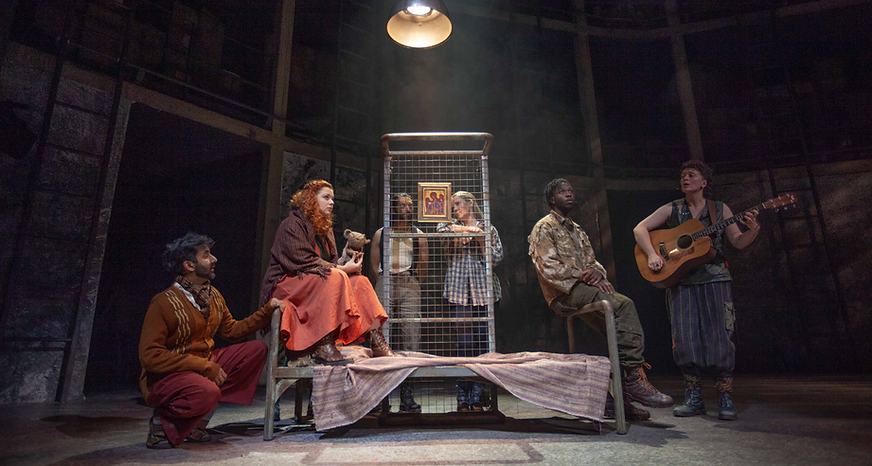
A departure from our normal family theatre trips, but with a daughter studying Brecht as one of the practitioners for her GCSE and the casting of Carrie Hope Fletcher, this was a no brainer. I have not really thought much about Brecht since university where I remember studying Mother Courage and her Children(and playing Mother). This was also a new theatre for us – though it wasn’t so good that it ended up being a strike day as we had to drive!
Written in 1944 The Caucasian Chalk Circle is based on an old Chinese play: The Chalk Circle. The ‘Caucasian’ part refers to the setting of the play which is Georgia in the Caucasus region (named as Grusinia in the play). It focuses on the story of a peasant girl who rescues a baby abandoned during a revolution and raises him as her own. In the climax of the play she has to prove that he is hers.
I was very impressed with the theatre from the moment we entered the auditorium. The open set consisted of a series of metal beds, both with and without bedding, and during the last 10 minutes before it started the cast came out bit by bit onto the stage and in character to take up their positions.
As it started it was clear that we weren’t in the 1940s setting that Brecht wrote it in. Costumes (designed by Oli Townsend – who also designed the set) where more modern than that and we were also presented with a UN official in a blue hi-viz jacket. This opening scene is the framing for the play. Brecht is a proponent of what he called ‘epic theatre’. One of the key elements of this is that of a play within a play. Here we had refugees in a UN refugee camp, arguing about who should be prioritised to either go home or move on. This leads to a discussion on how the UN plan to make land, decimated by war, fertile again. To pass the time, the UN have arranged for a performer to come and perform a play for them. As the performer, Singer (played by Zoe West) arrives, she informs the refugees that they will not just be watching a play but performing in it. She proceeds to allocate parts.
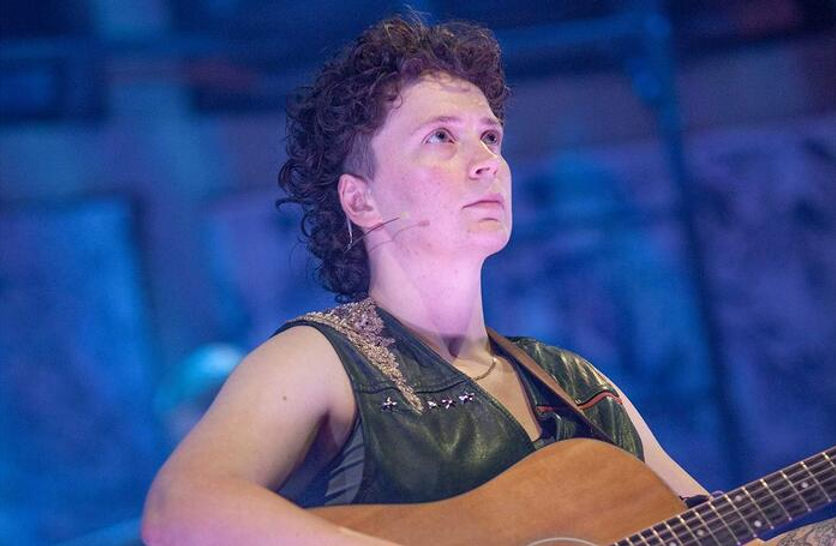
Zoe West
Another thing that Brecht was very firm on was that an actor should never fully inhabit a part and that the audience should always know that they are actors. Whether intentional or not this was apparent when Singer asked for someone to play the servant girl, Grusha, and she had to be able to sing. As Carrie Hope Fletcher shot her hand up in the air there was an audible laugh from the audience.
As the actors are not supposed to fully embody their character, costume in Brecht’s plays are often small elements that suggest the character. This was followed here, with each member of the cast being given things like a hat, or an apron, or a scarf, to suggest their characters.
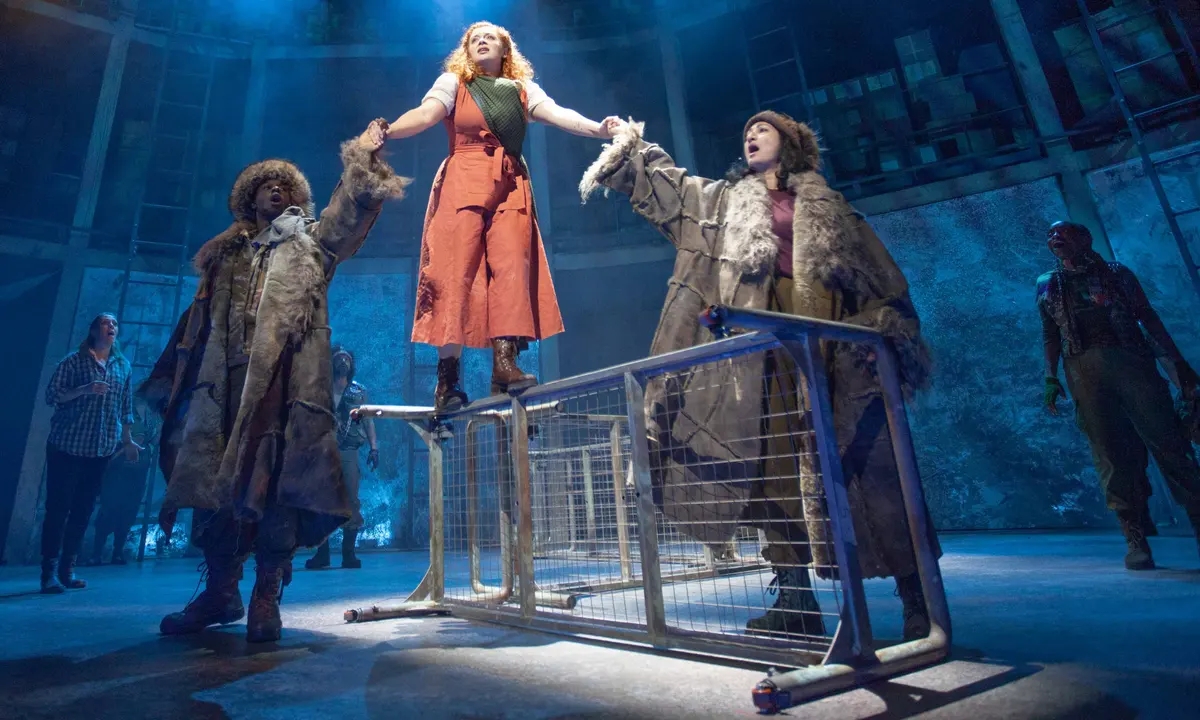
Joanna Kirkland, Nickcolia King-Na’da, Carrie Hope Fletcher, Bridgitta Roy, and Adoela Yemitan
As the ‘play’ began the metal beds were used in a variety of ways to suggest fences, balconies, windows, tables, etc. Once again, in keeping with Brechtian technique there is no realistic elaborate set pieces. With the exception of three actors, each played multiple roles (up to 50 between them) and the change of character was merely a change of hat, or jacket, or shirt. As I spotted all the Brechtian techniques I could feel my inner drama student nerd coming out! I have read reviews that criticise this liberal use of costume that appears to come from a mish mash of time and place. And this is of course how it should be: remember, as an audience we should always be aware that we are watching a play and not reality.
Director, Christopher Hayden, absolutely made the most of the stage at The Rose Theatre. Ladders lead up to the upper level around the back of the stage and these were used throughout the production. Once again the Brechtian techniques were clear in the direction. Singer frequently addressed the audience, breaking the fourth wall, and then addressed the ‘actors’ out of their characters. She controls the action, and lets the audience know what is going to happen. I particularly liked when she told us, the audience, that this was her chance to join the play and be an actor. She then added: ‘well, a Brechtian actor’ (as of course we were still going to be aware that she was Singer).
Music plays a key role in this (even though it is a play) just as it does in many of Brecht’s plays. For the original production Brecht himself wrote ‘songs’ to accompany the script, though today, productions tend to use their own original music. For this production the music was written by Michael Henry. The score is earthy and folk-like, all played by Singer on her guitar and/or vocal percussion from the cast. This is Carrie Hope’s Fletcher’s first play, and seems to be a good way of easing from musical to play.
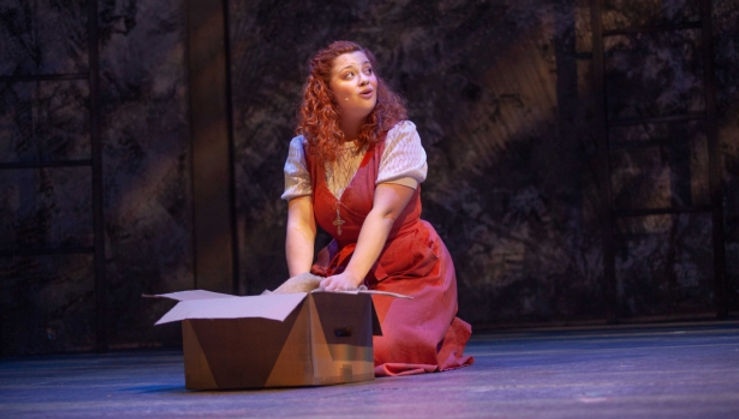
Carrie Hope Fletcher
Of course much of the publicity has focused on her casting (and I saw audience members in Les Miserables t-shirts which may indicate that at least some of the audience were there for her) but how did she fare? Exceptionally well! As the servant girl Grusha she gives a strong performance, and her voice makes light work of the score. It was actually nice to hear her not belting out numbers and instead her voice carries the melodies as she wrestles with her decision to raise the child as her own.
Another standout was Jonathan Slinger as the judge, Azdak. Largely absent from Act 1 he reappears at the beginning of Act 2 as we move away from Grusha’s story into Azdak’s in what appears to be a completely different play – a disconcerting point until you realise how this will link into Grusha’s story.

Jonathan Slinger
Above all this is an ensemble piece. In fact the cast list in the programme lists every actor as ‘character’/ensemble). They are Adeola Yemitan (Aide), Bridgitta Roy (Cook), Joanna Kirkland (The Governor’s Wife), Nickcolia King-N’da (Simon), Ronny Jhutti (Corporal) and Shiv Rabheru (Laurenti).
As we reach the end of the play we are presented with the titular Caucasian Chalk Circle. Brecht alters this from the ending of the Chinese play on which it is based as we come full circle to the argument at the start of the play about fertile land and who should get to farm it. This is ultimately the moral. Resources should belong to those who will care for them and allow them to flourish. Brecht never intended that his audiences be entertained, but that theatre should make them think and engage with social issues – and possibly revolution. Will this production lead you to revolt? It’s unlikely. But it may make you think. What I really loved about it was that it will introduce a new audience to the Brecht and teach that theatre is so much more than blockbuster musicals and that Brecht is not just for drama students!
More like this, please!
The Caucasian Chalk Circle plays at the Rose Theatre, Kingston until October 22nd
https://rosetheatre.org/whats-on/the-caucasian-chalk-circle
Photos © Iona Firouzabadi
 Act 1 Beginners