
★★★★☆

This play is a personal favourite of mine. When I was a teenager I became obsessed with the history of the Salem Witch Trials and I played Mercy in a production of The Crucible at uni. But I until now I had not actually seen it.
This has been a huge success for the National with tickets selling incredibly well and I was not disappointed.
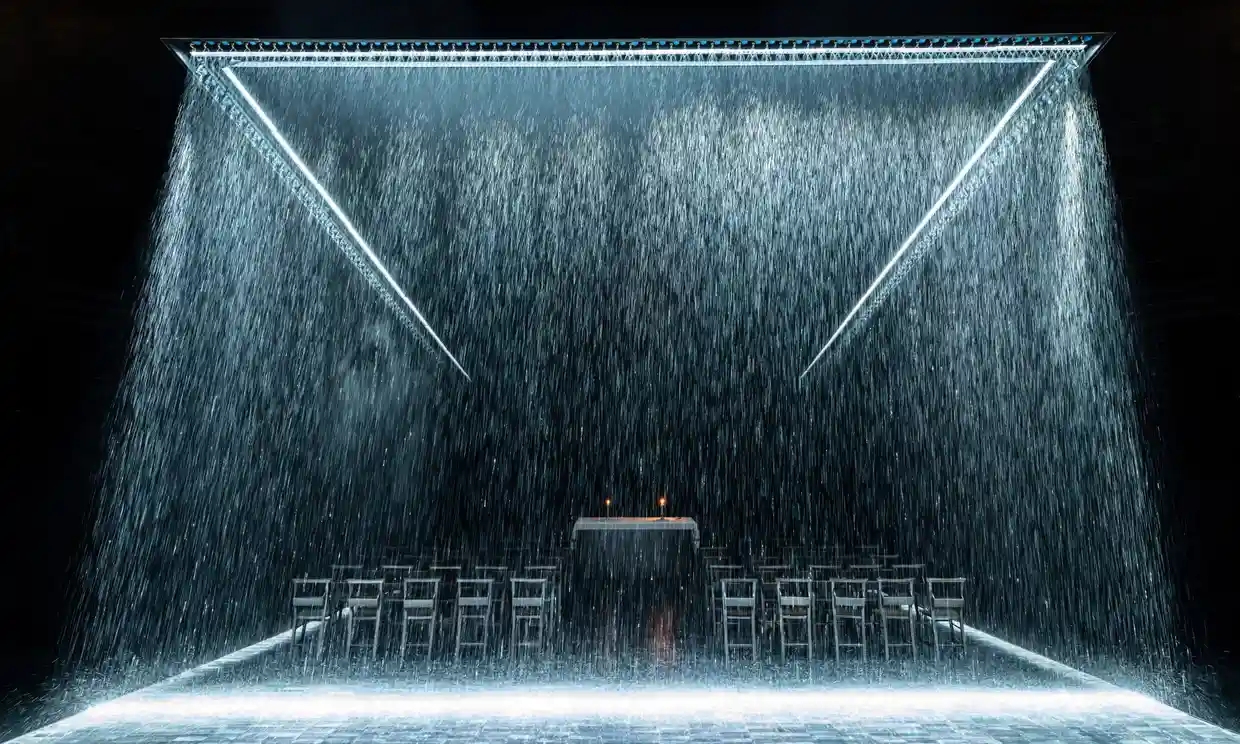
If you’ve seen anything about this show on social media you have no doubt seen photos of the stage as the audience enter with the rain curtains. This is very impressive piece of set design (by Es Devlin) and works well at setting the mood for the play. It hides the very basic set which really just consist of chairs and tables, rather than large set physical pieces.
Last seen in London at The Old Vic in 2014 (and last seen at the National in 1990) this is one of Arthur Miller’s most enduring plays. Set in 1692 it deals with the Salem Witch Trials which saw more than 200 – mostly women – accused of witchcraft and 20 executed between February 1692 and May 1693. Whilst this provides the setting, it is about much more than these historical events. First performed in 1953 it is a commentary on the so-called McCarthy Witch Trials when Americans were accused and questioned by the House of Representatives’ Committee on Un-American Activities. It is about mass hysteria and fear of people who might be different to you. Fear of change and clinging onto the life that you feel comfortable with.
This is truly an ensemble piece and that is how it starts. Rather than going into the first scene director Lyndsey Turner has decided to begin with a church service which immediately sets this up as an ensemble piece. This then segues into the girls who end up as the accusers directly addressing the audience and using Arthur Miller’s prologue which does not form part of the actual script. This sets it some of the historical background to the community in Salem and plants the seeds in the audience mind of a piece that will not only show events from 1692, but also act as a commentary on society that is still relevant today.
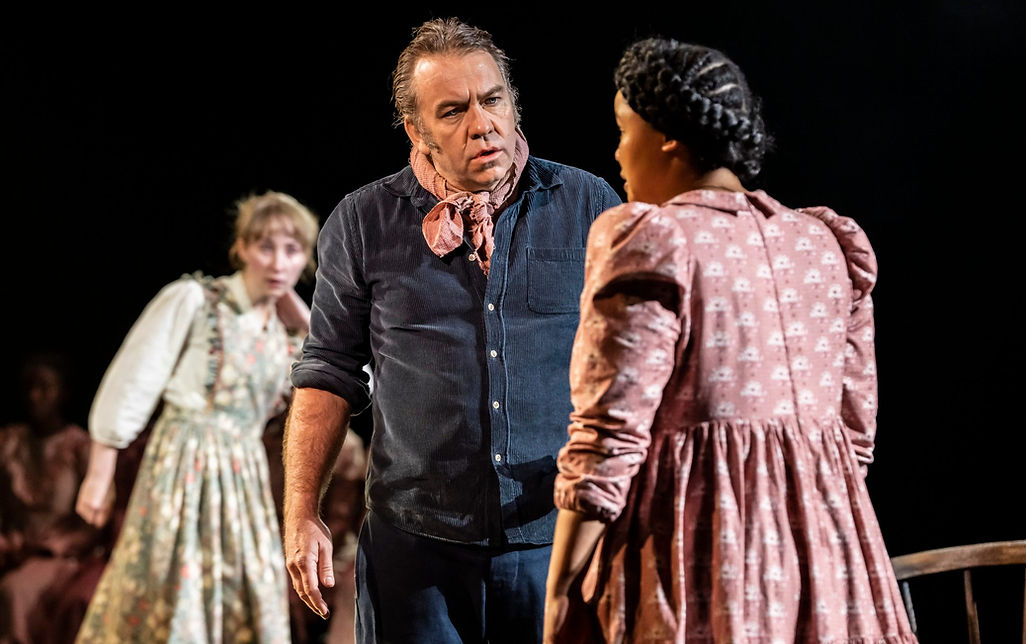
Erin Doherty, Brendan Cowell, and Rachelle Diedericks
Brendan Cowell took on the role of protagonist John Proctor with a very commanding stage presence. We saw his character go through many changes during the play, from the outsider farmer to a man broken by events that spiralled beyond his control. His scenes with Eileen Walsh as Elizabeth Proctor were especially engrossing with both actors portraying a distance between the characters, but at the same time a clear touching affection, which comes to a head when Elizabeth is accused and John tries to protect her. Eileen Walsh herself gave a fantastic performance of a woman who can’t quite believe what is happening and tries to see through the madness and hysteria that has permeated the village.
Erin Doherty took on the role of Abigail Williams (most associated with Winona Ryder from the 1996 movie). She perfectly captured the schizophrenic nature of the character, seeking to remain blameless for her actions by accusing the women of manipulating her using witchcraft. As the ring leader of the girls it was clear to see how they were captivated by her, through a mix of awe and fear. Erin Doherty’s mannerisms on stage were an integral part of her portrayal of a teenager who has been rejected and is seeking attention.
It is also worth mentioning the standout performance of Rachelle Diedericks as Mary Warren. It was hard to take your eyes off her in the second scene even when she wasn’t the focus. Her reactions to what was happening around her were on another level and you really felt for the character, being manipulated by Abigail and completely out of her depth.

Erin Doherty and Fisayo Akinade
The lighting design by Tim Lutkin made full use of the depth of the stage with some scenes taking place at the back of the stage and materialising out of the darkness. The costumes were designed by Catherine Fay and I particularly liked how the girls were all given the same colour palette to show them as a united group, with the dresses emphasising the fact that they are children.
The rest of the cast consisted of David Ahmed, Fisayo Akinade, Zoe Aldrich, Nathan Amzi, Stephanie Beattie, Jersey Blu Georgia, Halle Brown, Sophia Brown, Raphael Bushay, Anushka Chakravarti, Grace Cooper Milton, Hero Douglas, Henry Everett, Nick Fletcher, Colin Haigh, Una Herrmann, Karl Johnson, Martin Johnston, Grace McGonigal, Eve Marner, Matthew Marsh, Alastair Parker, Joy Tan, Ami Tredrea, Cadence Williams, and Tilly Tremaine.
In a time of fake news and conspiracy theories, The Crucible shows us the danger of remaining too insulated and not accepting others who may appear different. It’s more than an historical drama from the 17th century, or a political allegory from the 20th century. It speaks to us in the 21st century and encourages us to recognise hysteria and to not follow the crowd but apply rationality to our lives.
The Crucible is playing at the National Theatre until 5th November.
https://www.nationaltheatre.org.uk/shows/the-crucible
Photos © Johan Persson
 Act 1 Beginners