

For the last two months of 2022 this has been one of the hottest tickets in town, with a star name leading the cast, and a limited run.
Good is a play by CP Taylor which premiered in 1981, performed by the Royal Shakespeare Company. This new production stars David Tennant (‘Doctor Who’ and Good Omens’), Elliot Levey (most recently seen in Cabaret), and Sharon Small (‘The Threepenny Opera’, and ‘Lear’).
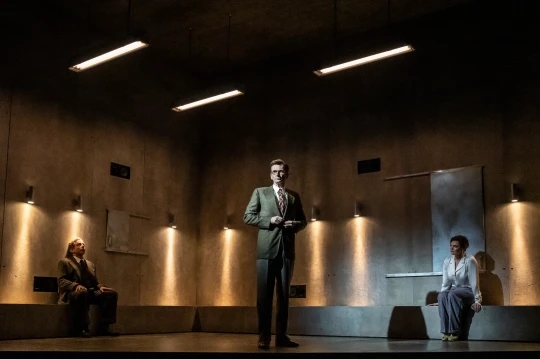
Initially written for 10 actors, director Dominic Cooke has reimagined it with a cast of only 3. Tennant plays the lead role of Halder throughout the play, whilst Levy and Small play all of the remaining roles.
Set in Frankfurt in 1933, Good is considered the definitive piece of English-speaking theatre on the subject of the Holocaust. It does not deal with the consequences of Nazism and antisemitism, rather it deals with the causes and asks how a liberal minded ‘good’ person can become a Nazi and hold such views. Halder is a liberal literary professor in his forties. He is the epitome of a ‘good’ man: devoted to his wife and children and caring for his elderly mother. His mother is suffering from some form of dementia and Halder is led to conclusion that euthanasia would seem to be the only way to end her suffering. These views bring him to the attention of the newly elected Nazi party who have far more sinister views on euthanasia. Over the course of the play Halder is drawn into the Nazi party until its final, chilling moments.
Tennant is outstanding in this role. He controls the stage, moving seamlessly from one scene to the next, and taking the audience along with him through 8 years of history. A time moves on he becomes more detached from those around him – a subtle change that Tennant skilfully portrays.

Levey too is remarkable. Playing multiple roles he (and likewise Small) switch from one to the other with a sense of ease. His prime role is that of Maurice, Halder’s sole Jewish friend. Some of the finest moments in the play are the discussions between Halder and Maurice. Unsure whether or not to be concerned about the increasing antisemitism in Germany, overlaid with the strong view that the Jews are important to the success of Germany and so nothing will be allowed to happen to them. Parallels are also bound to be drawn between this performance and Levey’s recent Olivier award-winning performance as Her Schultz in Cabaret.

Small repeatedly amazed me by her ability to switch between characters – particularly Halder’s mother and wife. Both were fully defined as individuals and she was able to switch between the two in the space of a word or two.

The set (designed by Vicki Mortimer) is simple whilst feeling claustrophobic at the same time, reducing the playing area to the front third of the stage at the most. The programme talks of the producers’ pledge to ensure that at least 50% of the set was made from previous theatre sets. Having seen The Seagull earlier this year at the same theatre, it was clear that the set for that formed the basic set for this production.
There are many things to take away from this. What is the ‘good’ of the title? The most obvious answer is that it tackles the question of how a good person can do such evil. Ever since the Holocaust people have asked how ordinary German people allowed it to happen. Why did they not speak up? How did they become entrenched in the Nazi regime and commit such horrific crimes? Here we have Halder who is convinced that nothing will come of the rise in antisemitism. He decides to join the Nazis because that seems to be the thing to do in order to get on, but rationalises to himself that he can always leave the party if he is asked to do something he considers wrong. Only he doesn’t.
But it also asks to what extent is a person really ‘good’? Thanks to Tennant’s portrayal we have a man who, on some level, lives in a moral vacuum. He has an affair and leaves his wife and children to whom he was so devoted – or appeared to be. So we are asked to consider if there really is such a thing as a ‘good’ person.
On a final level we can look at the concept of euthanasia. As Halder rises up through the Nazi party he comes to see euthanasia as a positive part of the Nazi programme of eugenics and the establishment of an Aryan master race. It should not be forgotten that the word ‘euthanasia’ means ‘a good death’.
There are clear parallels to society today. We see people who observe evil in the world and remain detached from it. We see the deaths of asylum seekers in the English Channel but there are politicians who refuse to speak up against it. Others who voted blindly for Brexit policies because they were towing the party line. ‘Good’ people in America who one one day in January 2021 were persuaded that the good thing to do was to demonstrate against what they saw as a stolen election.
On entering the theatre we were told that photos were prohibited at all times, including the curtain call at the end. Now that I have seen the play I am glad that they were so strict on this. An ending designed to shock needs to be unexpected.
Good is playing at The Harold Pinter Theatre until 7th January 2023. Tickets available at https://www.atgtickets.com/shows/good/harold-pinter-theatre/
Photos © Johan Persson
 Act 1 Beginners