
★★★★★
Ah, good ol’ Rogers and Hammerstein. When you go and see an R&H show you know what you are getting. Wholesome fun. Great songs that you know even though you don’t realise they are from a show (‘You’ll Never Walk Alone’ – I’m looking at you here). Big company numbers and choreography. Perhaps a dream ballet. And maybe a cute kid or two to add a real sense of community.
Erm … (cue record scratch).
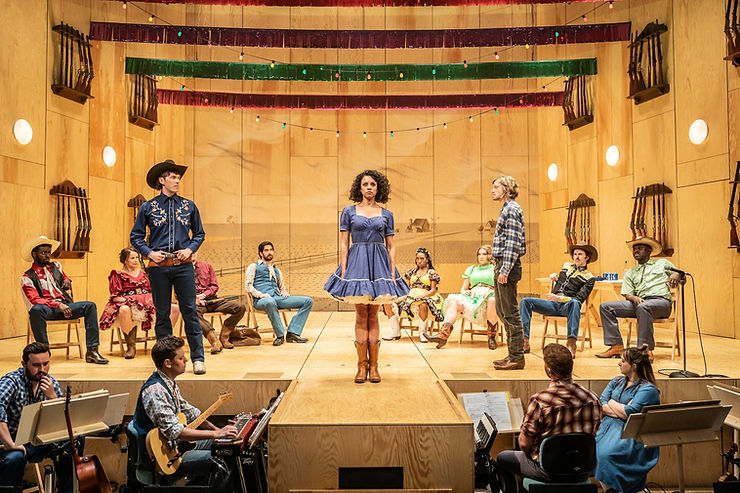
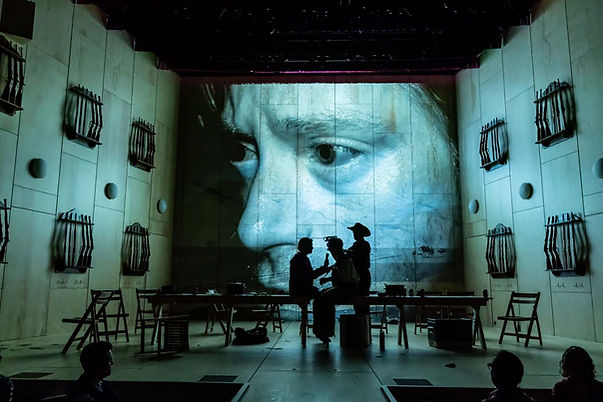
From the moment you enter the auditorium you know this show is going to be different. The interior of this 19th century, Grade II listed building has been completely transformed. Plywood and pine is everywhere, racks of guns line the walls, and metal foil bunting hangs across the stage and the auditorium. The bunting has the effect of blurring the boundary between audience and performer making you feel as if you are a part of it. The orchestra is not in a pit, but one the floor level with the stage.
This is the hugely successful – if controversial – production which ran on Broadway in 2019. It originally opened at the Young Vic last year before transferring to the Wyndham’s in February this year.
Directed by Daniel Fish who has tried to bring a community hall feeling to it, this production is clearly different from what we know Oklahoma! to be. The last time this played in London was in 1998 with Hugh Jackman (in the days before Wolverine), Josefina Gabrielle, Maureen Lipman, and Shuler Hensley (who won both the Olivier and Tony for his portrayal of Jud). That was a traditional full company production with a cast of 35 plus children. This has a cast of only 12. Daniel Fish has decided to forgo any lavish set pieces and make this about the characters – the small community and their relationships. If you think about it, the main drive behind the story is trivial and the possibly the ultimate in small town concerns – who is Laurey going to the box social with, and who will buy whose picnic basket. Okay, there’s a lot of other story lines going on, but I consider this to be the main plot line that moves from the opening scene onwards. So what we end up with is a production that feels smaller and more intimate.
If you aren’t familiar with this show (and I went with my son who knew nothing about it and ended up quite confused) then some of the directorial decisions are odd. Characters don’t always go off stage when their scene is done, but stay sitting on the chairs. This also means that they don’t necessarily enter scenes but just start talking. They also therefore appear to be on stage when their character is not traditionally in the scene. Having seen the 1998 production and done the show I had no problems with this but it is unusual.
The set (involving the wood, guns, and bunting) mentioned previously is designed by Lael Jellinek and Grace Laubacher. The stage remains largely bare throughout with trestle tables and chairs which are moved around at various points in the show.
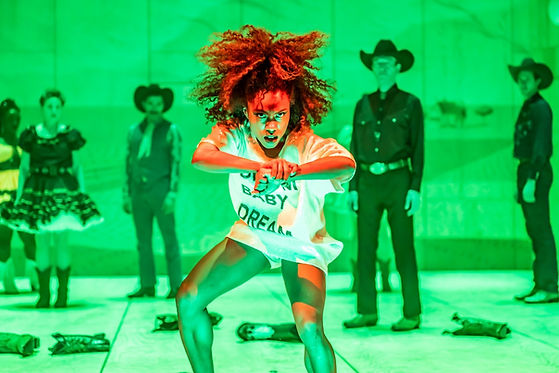
The costumes (designed by Terese Wadden) moves away from the early 20th century setting with jeans and more contemporary ‘Wild West’ style dresses.
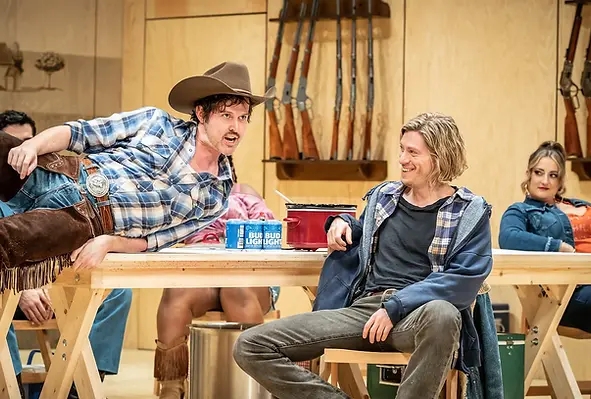
The lighting for this production (designed by Scott Zielinski) does need to be mentioned. Standing in the bar in the upper circle all you can see of the auditorium is an unnaturally bright light shining through the open doorway. As you walk it is clearly not the usual type of lighting you find in a theatre. Both the stage and the auditorium are lit to the same level of brightness. And as the show starts the lights remain on in the auditorium, and you soon realise that this is a permanent thing.
Well, permanent until the blackouts. I did spot a sign on the wall warning that there will be moments of complete darkness – but this was a whole other level! More on that later.
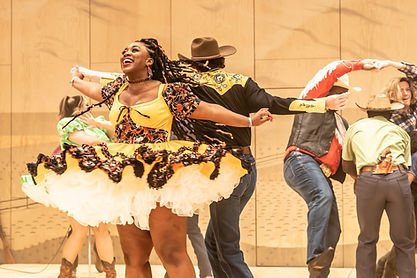
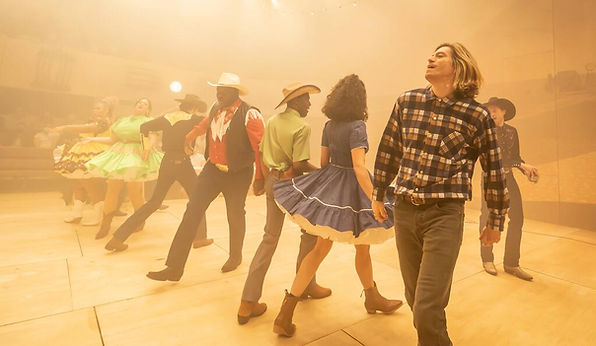
The choreography by John Heginbotham is undoubtably raw. The Dream Ballet is contemporary rather than balletic with the stage filling with smoke and the distorted sound of the familiar score. We see the confusion in Laurey’s dream, and is in keeping with this more modern take on the story. The rest of the choreography – especially in ‘The Farmer and the Cowman’ is quite far from the big splashy way that it is done, with lifts, and couple dancing. This is more foot stamping, barn dancing with thumbs stuck in the loops of belts and a bit of dosey doe.
The music (arranged by Daniel Kluger) has been modernised and stripped down to an 8 piece band, rather than a big orchestra. Basically, if you think you know the songs well, think again!
And what of the cast? Arthur Darvill plays Curly and his opening rendition of ‘Oh What a Beautiful Morning’ (accompanying himself on the guitar) sets the tone for the rest of the production. He is not the traditional romantic lead (as played by Hugh Jackman) but creepy and sneering at times. If he is meant to unsettle you as he makes his advances on Laurey he absolutely succeds.
Anoushka Lucas takes on the role of Laurey and she shines in the role. I last saw the show in 1998 and performed in it the following year and I thought nothing of the way the show is basically a fight between two men for a woman who appears to have no choice. However, in this day and age this sits uncomfortably and Anoushka’s portrayal of the character shows the uncomfortable situation that Laurey is often placed in. Her voice also soared, especially in ‘Out of My Dreams’.
Liza Sadovy played Aunt Eller and this was not the gentle Aunt that we have seen in previous productions. She was gruff and harsh at times whilst always maintaining a protective force around the community, as if holding it together.
Georgina Onuroah steals the show as Ado Annie and her rendition of ‘I’m Just a Girl Who Cain’t Say No’ was raw and powerful. On a side note, this song is not listed in the ‘Musical Numbers’ in the programme.
The rest of the cast includes Andrew Berlin, Raphael Bushay, Shane Cantor, James Patrick Davis, Anita Marie De Freitas, Stavros Demetraki, Greg Hicks, Rebekah Hinds, George Maddison, Marei-Astrid Mence, Briana Ogunbawo, Phillip Olagoke, Finlay Paul, and Helen K Wint.
One of the biggest changes to the story in this production is the portrayal of Jud. Patrick Vail is outstanding in this role. We no longer have a villain, preying on Laurey, but a more gentle, simple, man who is victimised by Curly.
Jud takes centre stage in two of the biggest ‘decisions’ when it comes to the staging. The scene with ‘Poor Jud is Dead’ takes place in complete darkness. We have Jud and Curly sat on the tables facing each other but in a blackout. All we see of the scene is. Jud’s face as a camera man comes onstage and stands with a camera pointing directly at him and projected onto the back wall. This really draws out the fact that Curly is ultimately trying to persuade Jud to kill himself so that he can have Laurey. Jud is not sinister, Curly is.
The other big directorial decision comes at the end of the show. In the original production a drunk Jud stumbles into the celebrations for Curly and Laurey’s wedding and goes to attack Curly with a knife. There is a fight and Jud falls on his knife and dies. The community decides that it was an accident and Curly’s role in the fight played no role. Jud’s death is dismissed and the heroes of the story head off on their honeymoon. Here there is no knife and no accident. Instead he is shot by Curly – leaving Curly and Laurey covered in splattered blood. Despite the fact that it is no accident the town still holds their mock trial and Curly is declared ‘not guilty’. However the rousing finale is not so joyous, but a defiant rendition of ‘Oklahoma!’.
A ‘great’ place but one where if you are different you will be shunned.
We don’t like the idea of men ‘belonging’ to women in today’s society and this is where the problem lies with the source material. That doesn’t mean that old shows that have values we don’t necessarily agree with in the modern age should be discarded, but perhaps we have to do – as Daniel Fish has done here – find a way to still stage the show, but to bring our attention to the fact that things have changed. The hero of the show is no longer the ‘ideal’ man. Male toxicity is brought to the fore and made obvious for all to see – and is not celebrated. It asks if America really is the ‘land of the free’ or is it only the ‘land of those willing to fit in’.
I’ve seen this described as ‘Woklahoma!’ – and yes, it is unashamed in making the audience aware of the way women were treated in the past and that we see it as unacceptable now. I don’t see this as a bad thing and it has made me reassess the show that I thought I knew. It is raw, it is in your face, it demands that you face the realities and think about it.
Oklahoma! changed the face of musical theatre in 1943. It redefined the genre and what it could do. In 2023 Oklahoma! is once again setting new boundaries.
Edited to add: Since writing this my son has gone back to see it. After the first viewing he thought the performances were amazing. After reading more about the story and watching the 1999 pro-shoot of the Hugh Jackman production, he fully appreciated what the director was trying to do and got so much more out of it.
Oklahoma! is playing at the Wyndham’s theatre until the 2nd September 2023. Tickets available here – https://www.oklahomawestend.com/tickets/
Photos © Marc Brenner
 Act 1 Beginners