
★★★★★
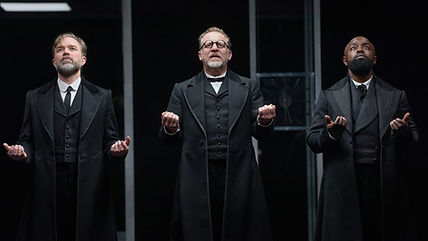
You have to admit – this doesn’t sound like an appealing premise. A three hour, three act play about the collapse of a bank that caused the financial crash in 2008. However with Olivier nominations and Tony awards this comes with a pretty solid reputation.
Originally opening at the National Theatre in 2018 and transferring to Broadway in 2021 (delayed by Covid) this is its second West End transfer. It retains the same design and staging as the original.
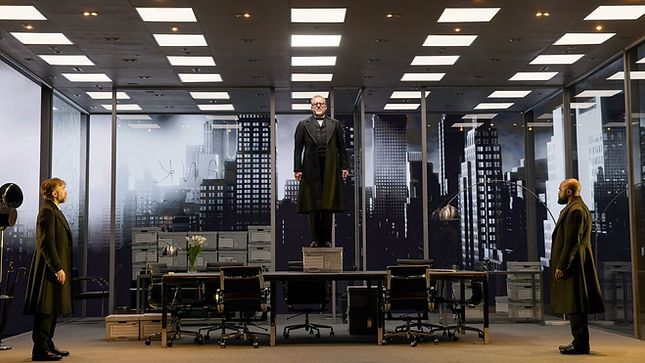
The Lehman Bank was the first to collapse in September of 2008 after the mortgage sub-prime scandal and this kick-started the financial crash. And this is the opening scene. An office in Wall Street inside a giant glass box, filled with archive boxes and a janitor. A voice on the radio sets the scene. This is deadline day: the bank is on life support. We are then transported back to New York in 1844 when a young immigrant arrives from Rimpar, Bavaria. Henry Lehman (Nigel Lindsay) is the oldest brother, and he is soon joined by his young siblings: Emmanuel (Michael Balogun) and Mayer (Hadley Fraser).
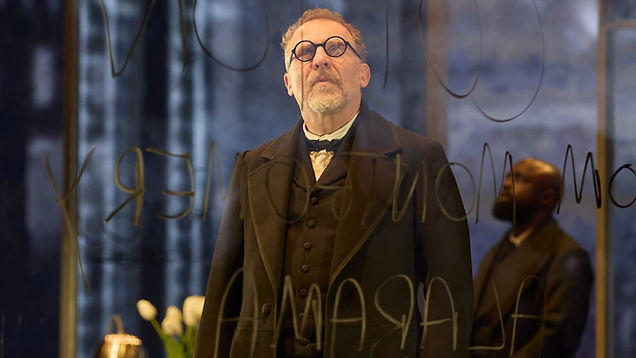
Nigel Lindsay as Henry Lehman
There is no doubt that this is a tour de force from each of the actors. They command the stage throughout each of the one hour acts, playing a multitude of characters. As the action moves through 164 years the three actors play the future generations plus those who ultimately take over the bank in Act 3. You feel as if you are watching an acting masterclass as they play anything from a small child, sitting on their father’s lap, sucking their thumb, to an 85 year old bank owner.
Each act takes us through a period in the life of the bank. Act 1 – entitled ‘Brothers’ – tells of their arrival in America and how they started a shop selling cloth, to buying cotton from plantations and entering the world of trading. It ends with the death of Henry. Act 2 is ‘Fathers and Sons’ and looks at Emmanuel and Mayer’s relationships with their children and how the bank came into it’s own. If Act 1 is about beginnings, Act 2 is about building and inheritance. Act 3 is ‘The Immortal’ and deals with end of the Lehmans’ ownership of the bank and its ultimate downfall and the present day. Each act feels very distinct and this certainly contributes to the fact that it doesn’t feel like a 3 hour play.
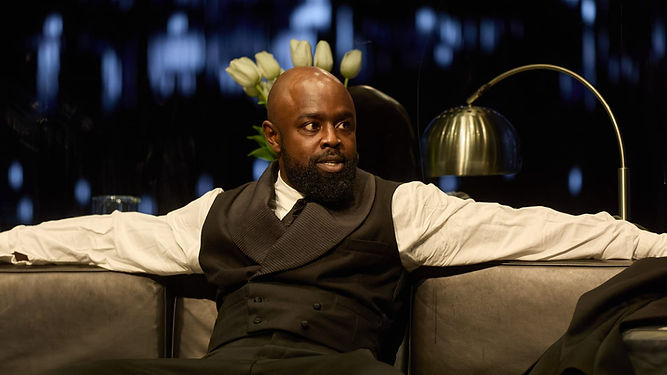
Michael Balogun as Emmanuel Lehman
The Lehman Trilogy was written by Italian playwright and novelist Stefano Massini. It originally ran at 5 hours but, thankfully was cut down. The English language version was translated by Mirella Cheeseman and then adapted by Ben Power. It is a testament to the writing that this play is accessible to someone who knows nothing of the financial crash or how banking works.
The set design by Es Devlin is simple: a giant glass box separated into 3 rooms which spins on a central revolve. Director Sam Mendes allows the actors to move seamlessly throughout the space. The archive boxes which occupy the space are transformed into chairs, steps, podiums in Wall Street, and even a tight rope.
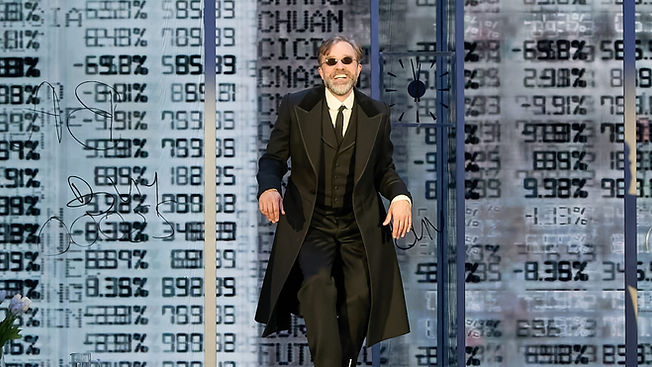
Hadley Fraser as Mayer Lehman
However, despite all this, I am conflicted. As I’ve said, you cannot deny that from a theatrical perspective it is first class. I would recommend it to any acting student to see how the job SHOULD be done. But there is one big issue with the play.
The Lehman Brothers were Jewish and arrived, as many Jewish immigrants did from Europe, escaping antisemitism. And like all immigrants they sought to better themselves in order to survive. This is a common feature of immigrants as they are often alone in a new country without family to fall back on. A strong work ethic helps to get the brothers where they are. Their Jewish belief is heavily emphasised in Act 1. The first thing we are told about Henry is that he is ‘a circumcised Jew’. There is a mezuzah on the doorpost of their shop. They pray together in Hebrew. As their business becomes more successful they cry out ‘Baruch Hashem’ (‘Blessed is God’). They sit shiva when someone dies.
The play has been accused of playing to the antisemitic trope of Jews and money and emphasising their Jewishness too much. When I saw this two women left during the third act calling out that it was disgraceful. I can only assume that this is what they were referring to.
This is certainly something to bear in mind whilst watching it. The play does show that by the time greed and corporate banking really took over there was no longer any member of the Lehman family involved. However enough people have raised concerns for me to be wary. The play does take liberties with how some of the events are portrayed which are problematic.
For this reason this was a hard review to write and giving it a rating was difficult. In the end I decided to base my rating on the play as a piece of theatre – the performances, the staging, etc.
The Lehman Trilogy is playing at the Gillian Lynne Theatre until 20th May
Photos © Mark Douet
 Act 1 Beginners